
I'm sorry that it's been a couple of months of silence from me.
In my last update in September I mentioned I was going to complete the Finance side for the next release - but in the middle of this work (during my most productive spell) my beloved dog of 15 years passed away.
I've had a very rough year but this loss hit me hardest. I tried to come back to the game multiple times since her passing but it's only been in the last few days that I've finally been able to concentrate and wrap up the work I was doing.
So this blog post is to show everyone how the game has progressed since the last update in September. You can also download the latest preview with all the new features mentioned below on the website as usual:

Let's start with the Balance Overview screen:
Everything is wired up now so you can actually see the impact of each business decision on your cash balance. As I've mentioned previously, I wanted to model a dynamic economy, so as a country prospers or fails, there's a knock on effect on your business. That means for example when the economy is heating up, people will have more money and your attendances and merchandise sales will shoot up.
As you can see in the video, you're able to take out loans as well which are connected to your company's outlook. The lenders give you a credit limit and rate based on a real time projection of how you'll do in the next 12 months, your credit worthiness, track record of payments and how well the economy is doing in general.

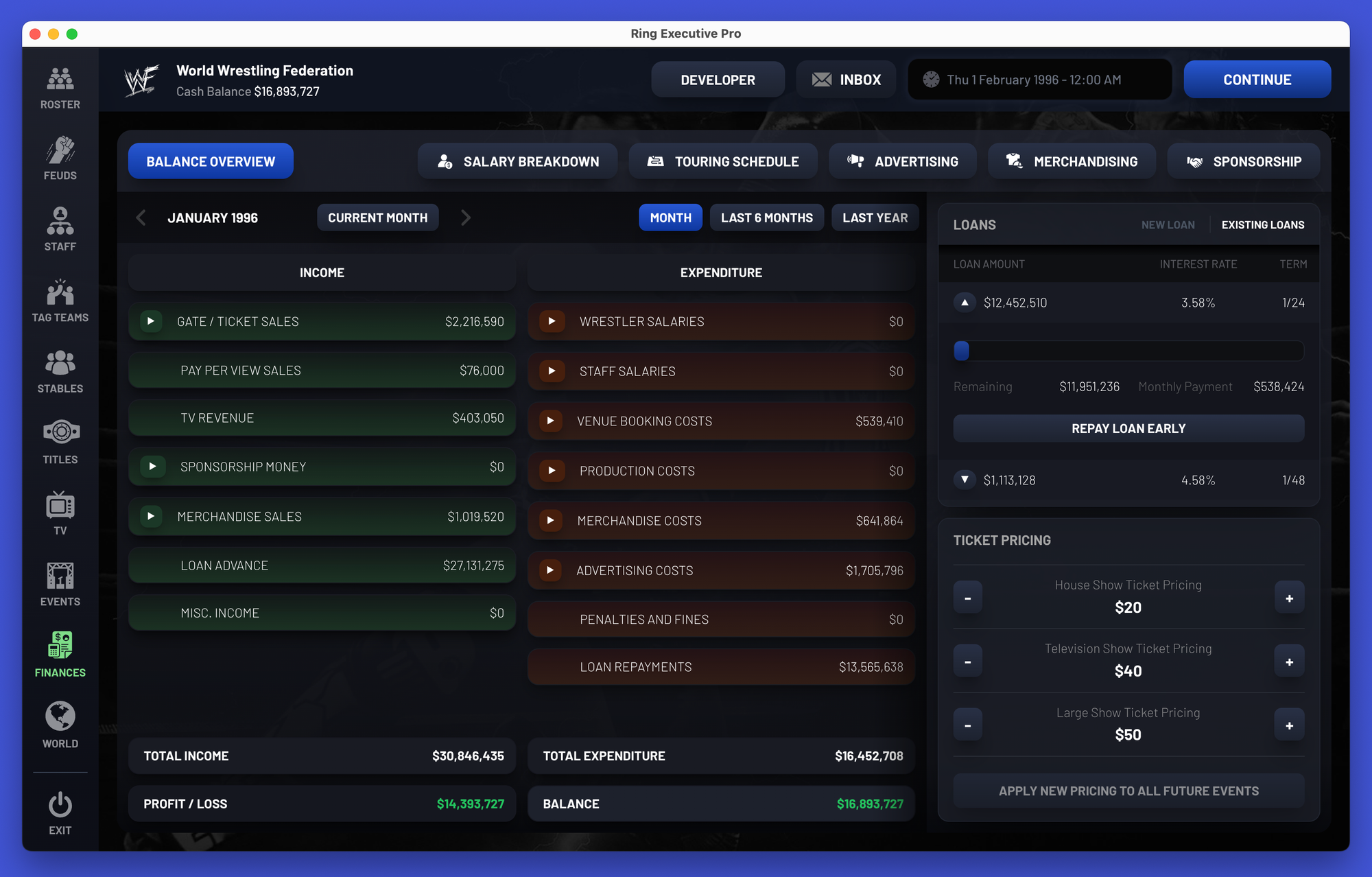
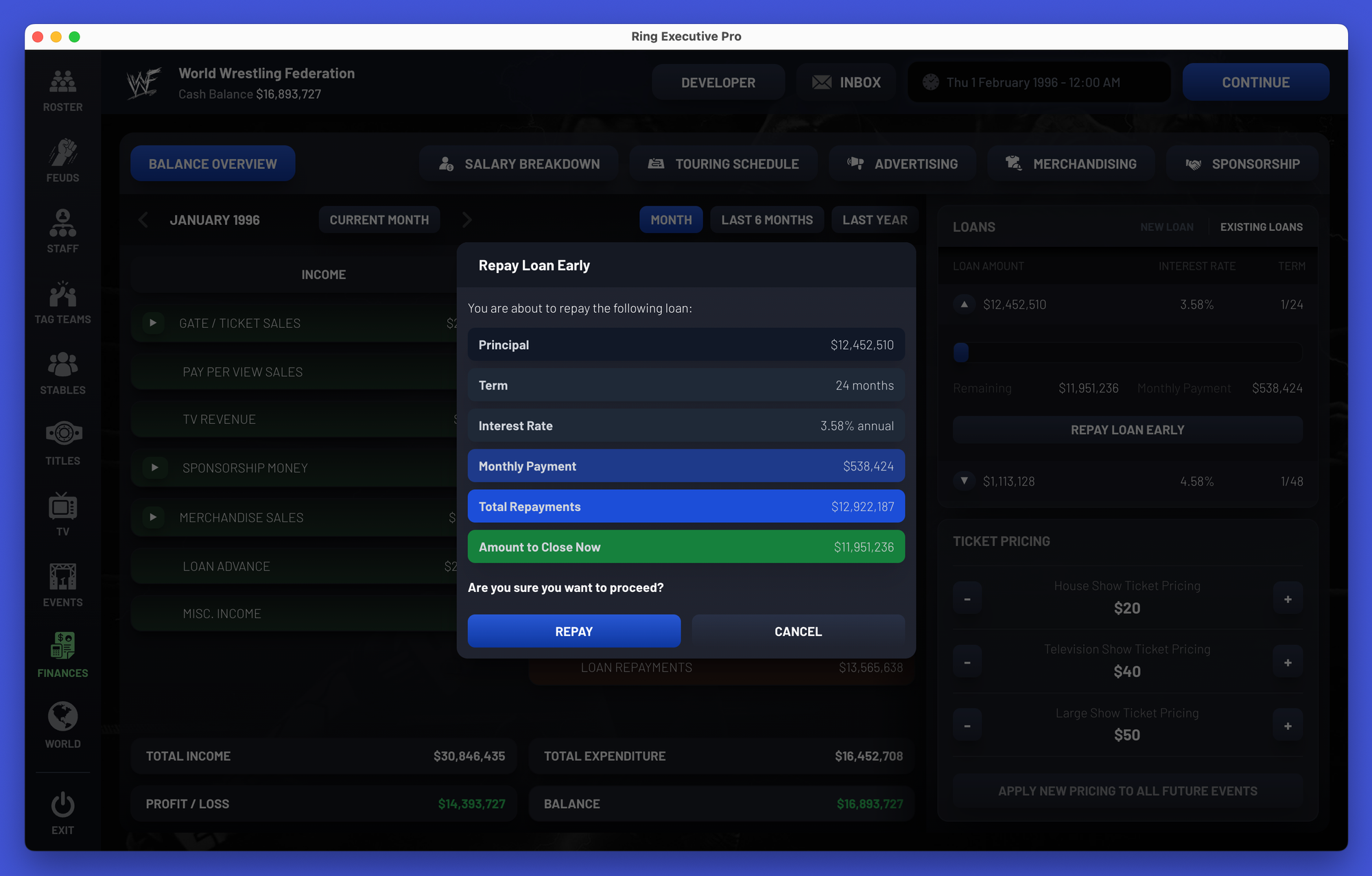
In our starter database (currently a 1996 scenario), the WWF only has a meager $2m starting cash balance and ECW far less, so the loans might be a lifeline and it also means you can get strategic...
When interest rates are low and it's nice and cheap to raise money - that might be the perfect time to take out a loan and get that developmental facility built.
Next, let's take a look at the Salary Breakdown screen:
The first thing to mention about this screen is that in Ring Executive Pro, you don't actually own the promotion. You're hired by the owner to be the Booker / GM of the promotion.
This means the budget you have in which to hire new stars and extend contracts of your existing wrestlers and staff members is given to you by the owner. Details about your budget (available, used, remaining) is shown at the top of the Salary Breakdown screen:

The budget available to you is calculated periodically based on a few factors.
- First, each owner is different - they have varying amounts of finance available to them. Some are more ambitious than others regardless of how big their wallets are.
- The other and most important factor is the relationship between you and the owner. This "confidence" value is calculated at regular intervals based on how well you are doing (in terms of raw numbers like profit, tv ratings, fan satisfaction) as well as how well you are implementing the owner's philosophy.
An ambitious owner, will estimate higher ticket sales which means estimating more revenue and resultingly give you a bigger budget. So be careful that you don't overspend even if the budget has been entrusted to you because if the owner has misjudged the market - there's only one person that will get the blame if you end up in the red!
The Salary Breakdown screen shows you how your roster is using up your current budget and allow you to adjust the number of people and the maximum you're willing to pay for each role.
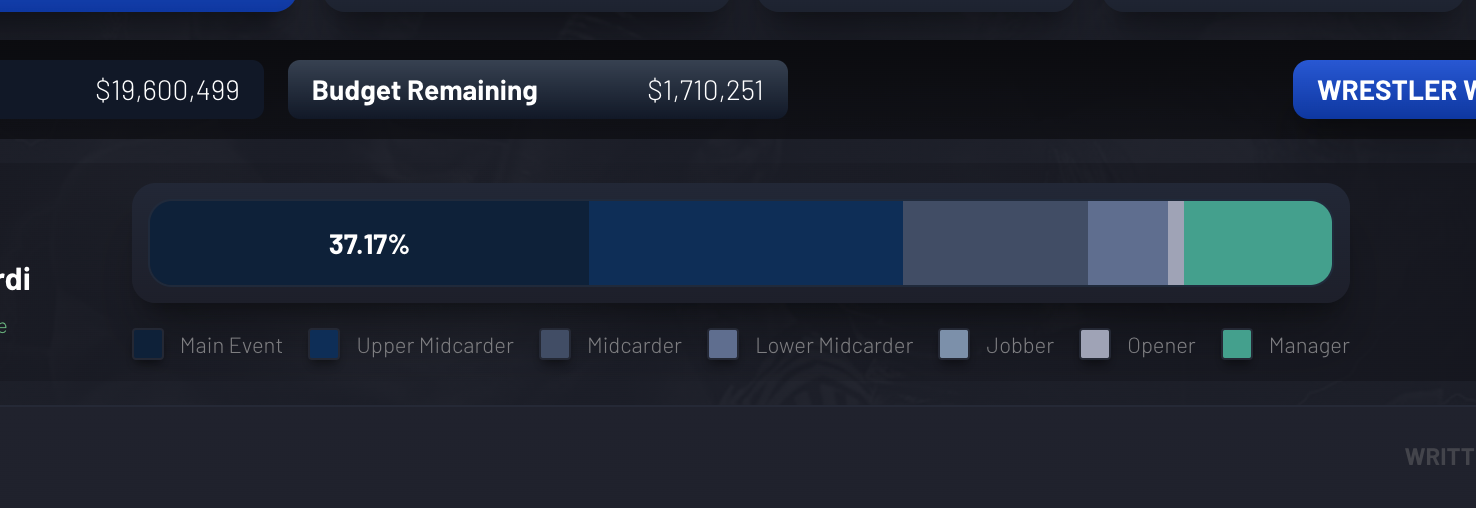
In some cases, you might end up taking over a promotion that has a lopsided budget - maybe you need more staff members but your budget is already full used up or you have ageing main eventers on high salaries not giving you room to maneuver.
How you spread your budget will affect your options when it comes to recruiting new people and extending existing contracts.
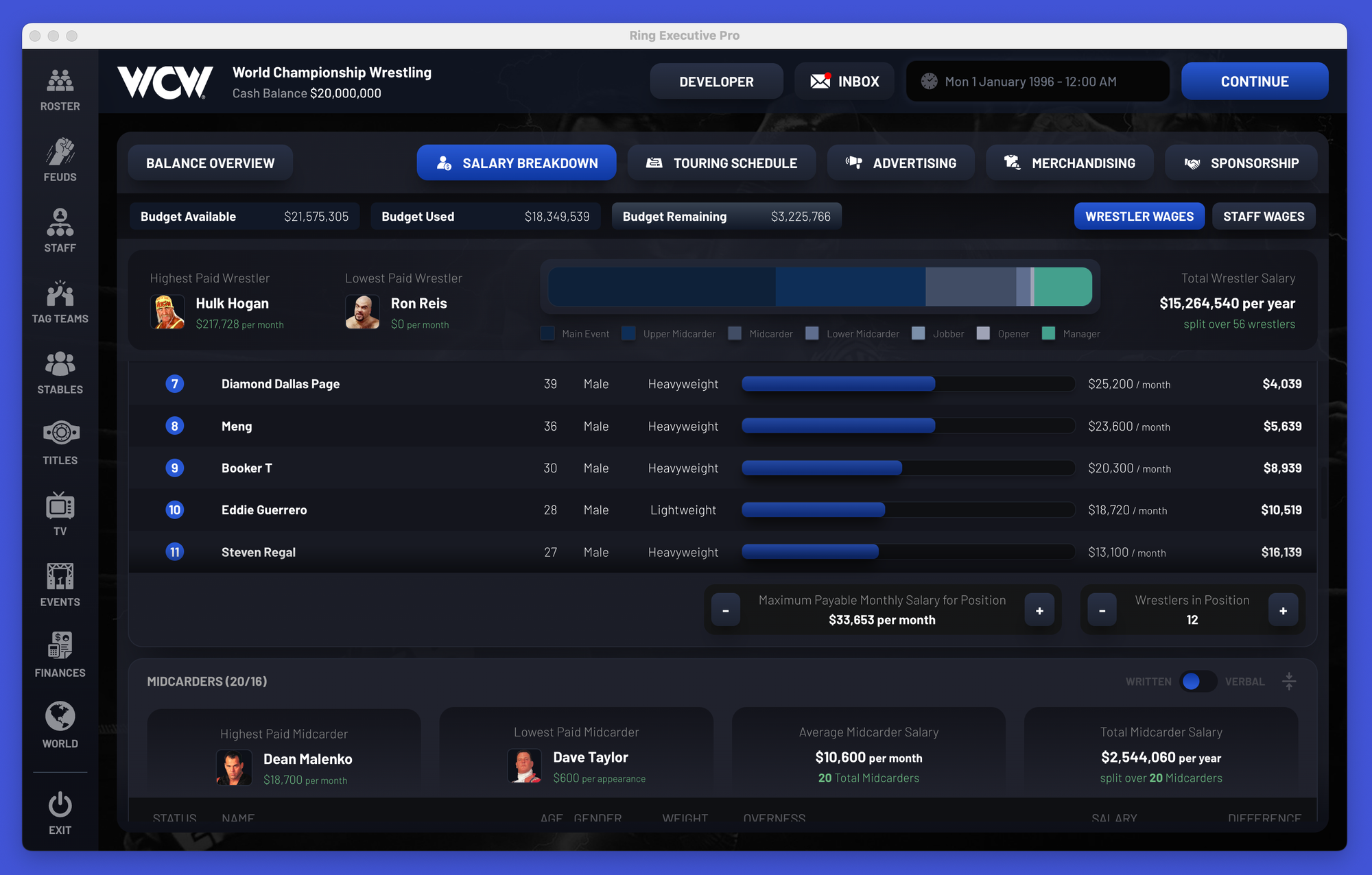

Example: If you have The Giant on $113k/month in your upper midcard but your budget is setup to only allow you to spend a maximum of $33k/month on that position - the options are:
- Low-ball him and hope he accepts
- Bump him up to the main event (if you have enough space) to offer him the same or slightly more than what he currently earns
- Let him leave
So you can see how important managing that budget becomes in terms of building the roster you want.
The Touring Schedule Screen
Despite having multiple revenue streams available to you (e.g. TV deals, merchandise, sponsorship etc) - the heart of your business model is touring the nation (or world) putting on shows and this screen shows you how each individual event makes an impact on your bottom line.

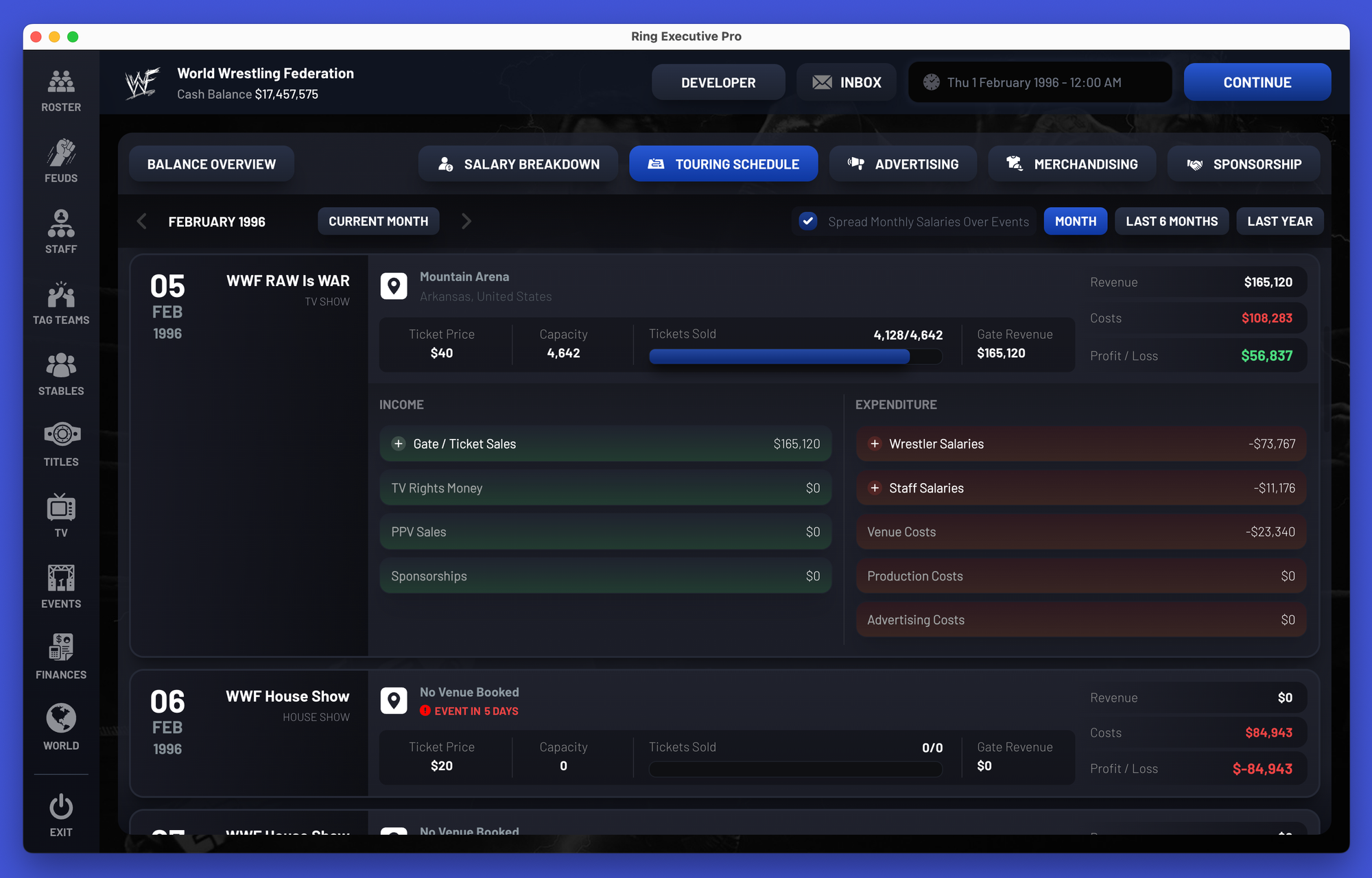
You'll use this screen in combination with the Events Calendar screen to manage all your live events:
- You can see which events made a profit or loss. By expanding the event you can also drill down into the associated income and expenses like gate receipts, salaries, television deal money etc.
- You can spread monthly written salaries over the period you're looking at to see whether an event actually made money or not. This helps you understand how healthy your touring business is, for example if most of your roster is on written contracts, an event might have made money based on ticket sales etc but overall you could have incurred a loss.
- See how upcoming events are doing: whether they have venues booked and what the ticket sales are like. This allows you to spot at a glance what events are struggling to sell out. You might be able to remedy flat ticket sales for an event by advertising it more.
Note, if you're seeing a lot of your events are selling out like in the screenshots/videos above - it means you might be leaving money on the table - either your ticket prices are too low or you're not booking large enough venues. If you are relying on the auto-booker to book venues for you, maybe your assistant is being too conservative and you need to step in.
The Advertising Screen
I'm really pleased with how this screen turned out. In a nutshell, the Advertising Screen allows you to promote the company, events or specific wrestlers.
It's quite straight forward to understand how advertising affects company popularity and ticket sales. There's a snowball effect where being consistent in promoting yourself will lead to steady growth. As you reach higher levels, you'll have to spend more advertising dollars to achieve results. To reach "global" status and maintain it, you'll need to spend like a global promotion on advertising.
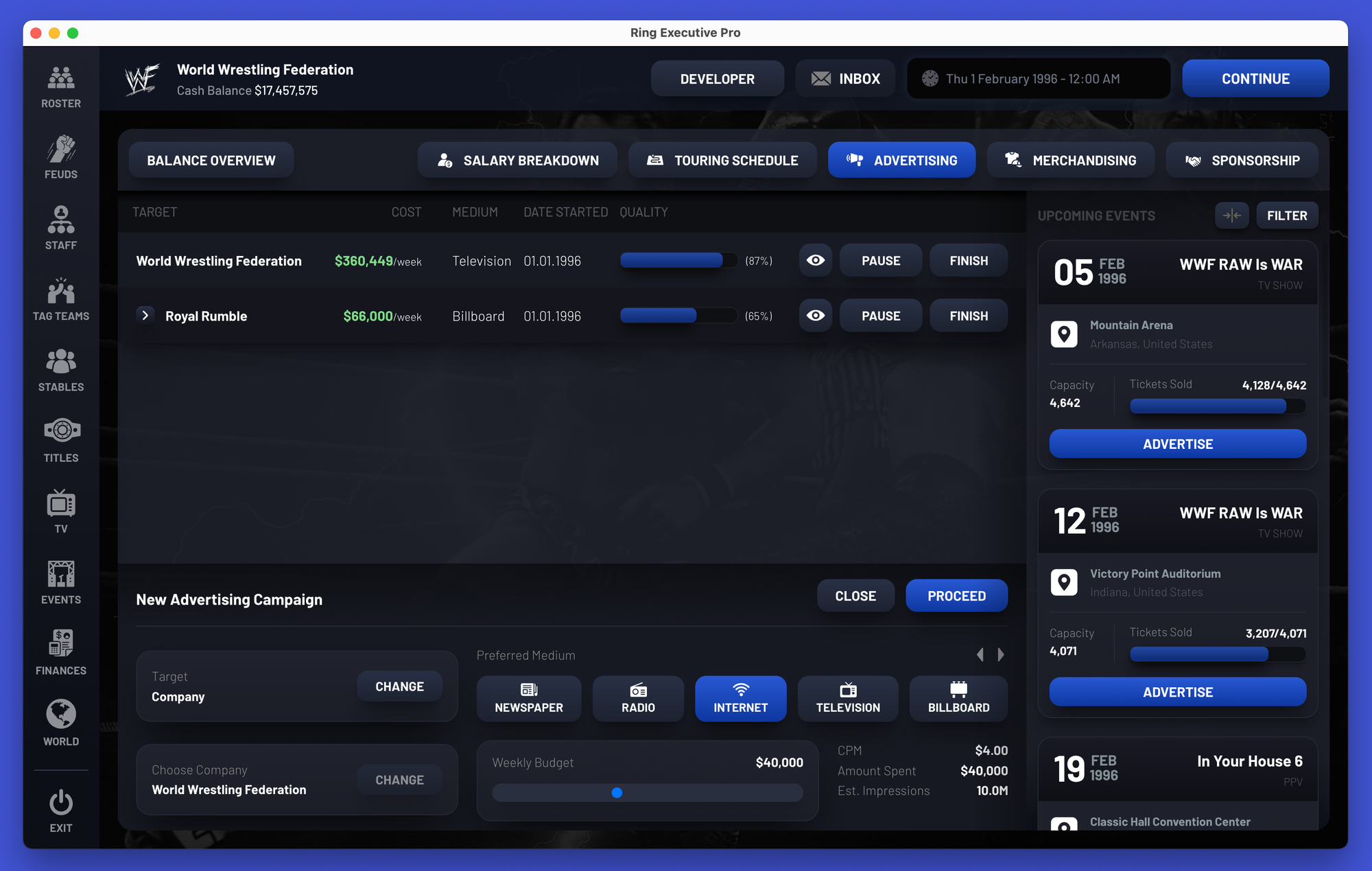
When it comes to promoting wrestlers, I wanted to make "creating a superstar" as grounded in reality as possible:
- Obviously the characteristics of the wrestler plays a huge part - whether they have the look, charisma and ability to get themselves over.
- Finally, without putting the weight of your machine behind a wrestler (i.e. advertising them), it will be impossible for a wrestler to reach their full potential.
Your investment in the wrestler in terms of time also matters - those skills won't be honed unless the wrestler is constantly out there getting reps.
So creating a "Hulk Hogan" level superstar requires finding a wrestler with innate ability and putting significant amount of time and money behind them.
When I designed the mocks, I hadn't gone into the details of how this would actually work - I felt it would be rather dry if you created a campaign and the results were simply based on the value the RNG spits out for the quality of the creative and how much you're willing to spend.
I don't want any part of Ring Executive Pro to feel poorly designed or just a "clicking" exercise.
So when you decide to create an advertising campaign - after you've decided on your budget and the medium (radio, television, internet etc) - the next step is to approach an advertising agency.
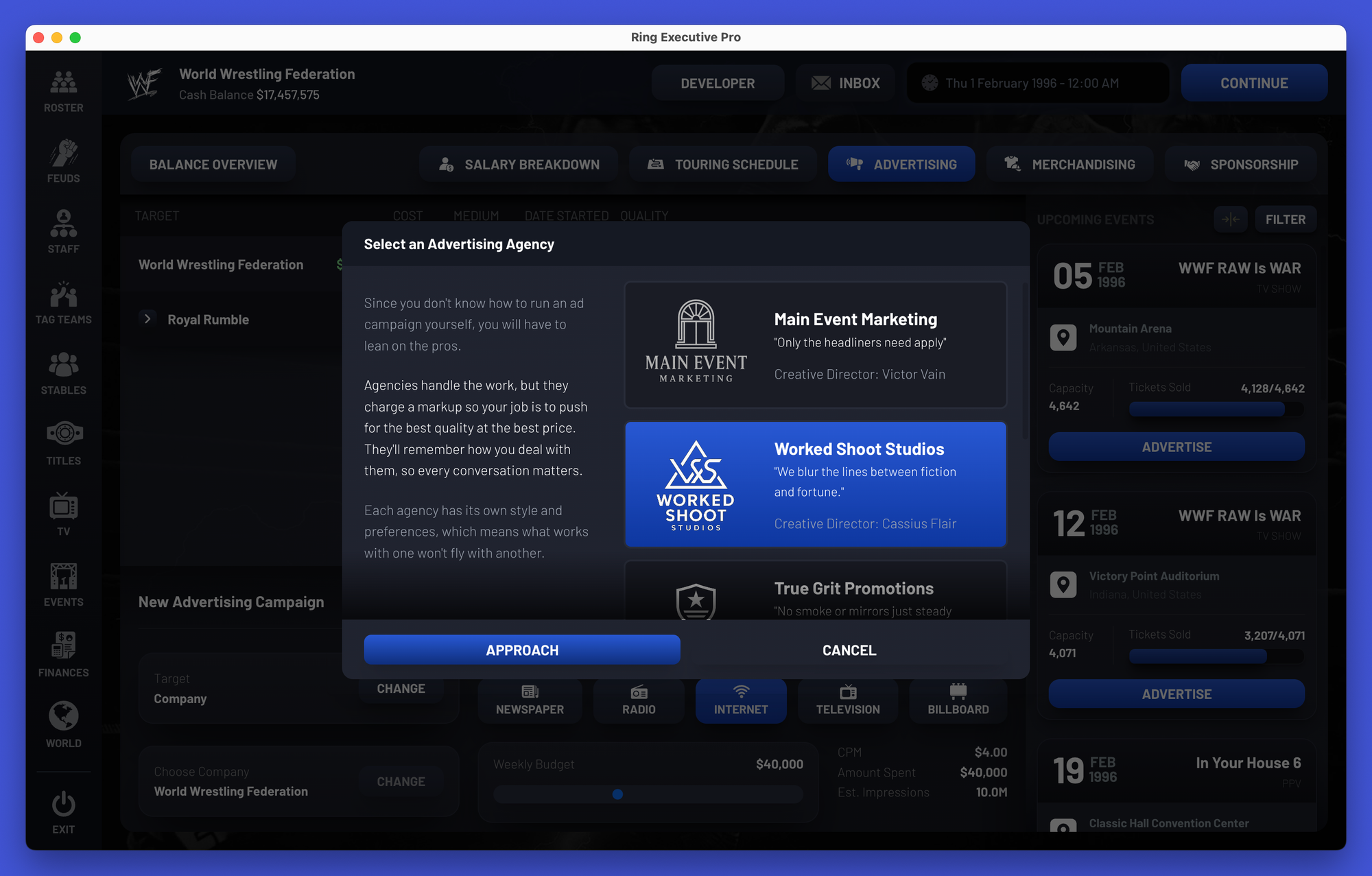
- There are 5 advertising agencies that represent the sort of companies you will experience in real life - from snobby premium luxury brands, flashy over-promisers to the reliable local establishment.
- The conversation you have with the agency will determine the quality of the work and also the markup you will pay for their services. If you build good long term relationships, you'll get discounts and better quality work.
- The agencies remember previous interactions so wading into the prestigious boutique agency with a meager budget and causing an upset might end up costing you when you need top quality results later in the game.
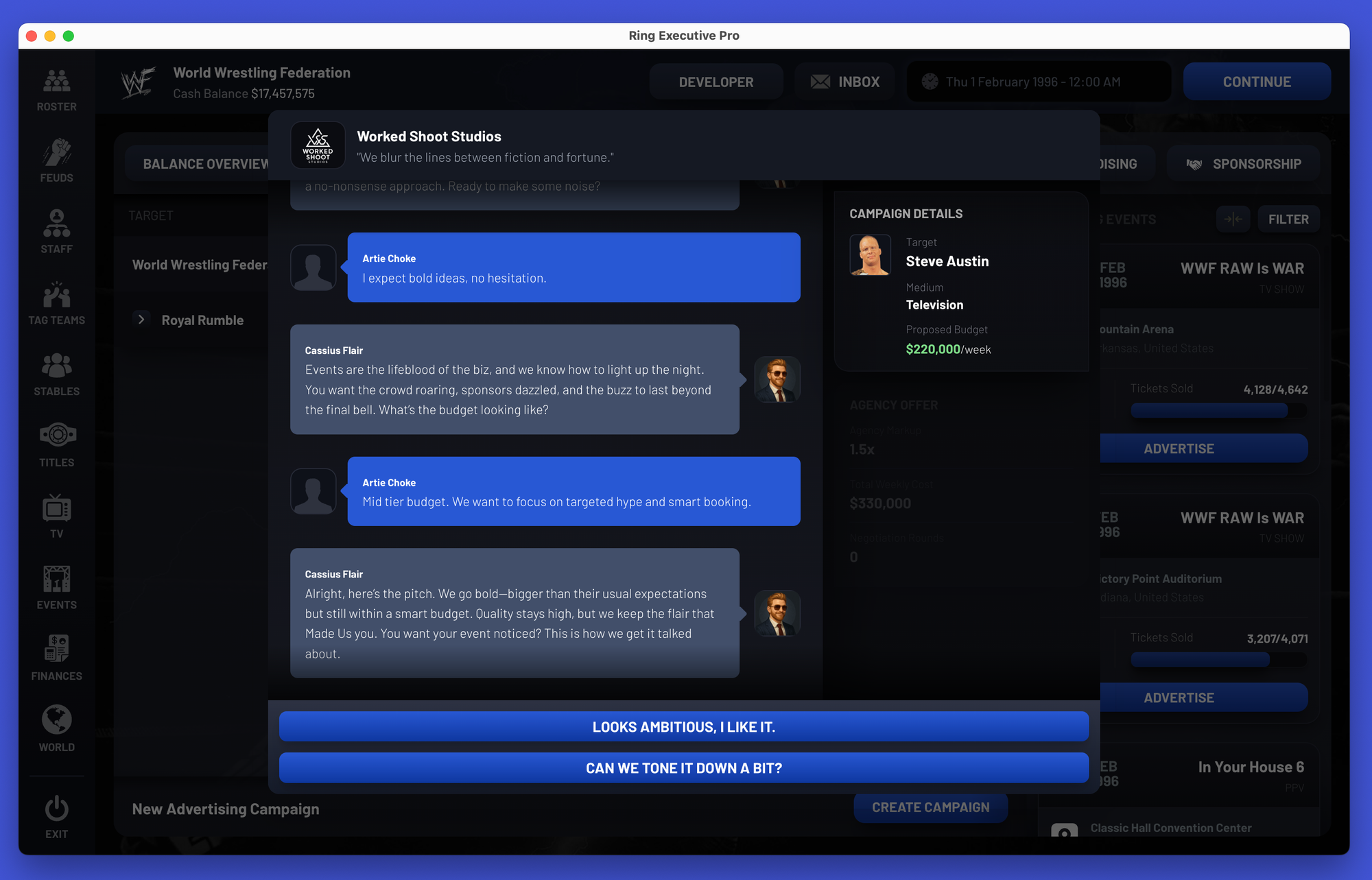
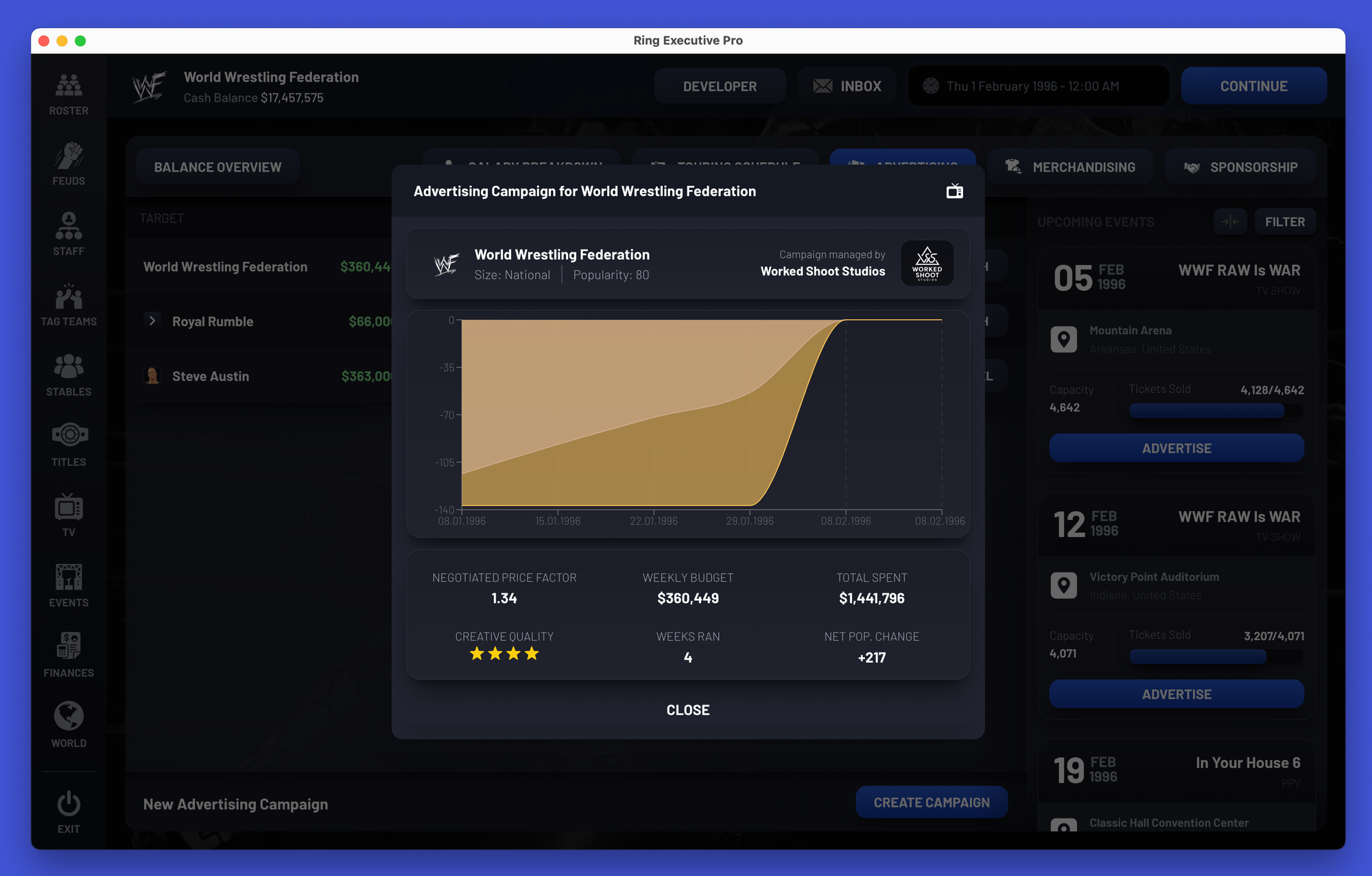
The other benefit of designing this screen was that it gave me the ground work of the UX that I'm going to use when I handle contract negotiations - which will be again interactions with the wrestlers that determine how the negotiations pan out.
The Merchandising Screen
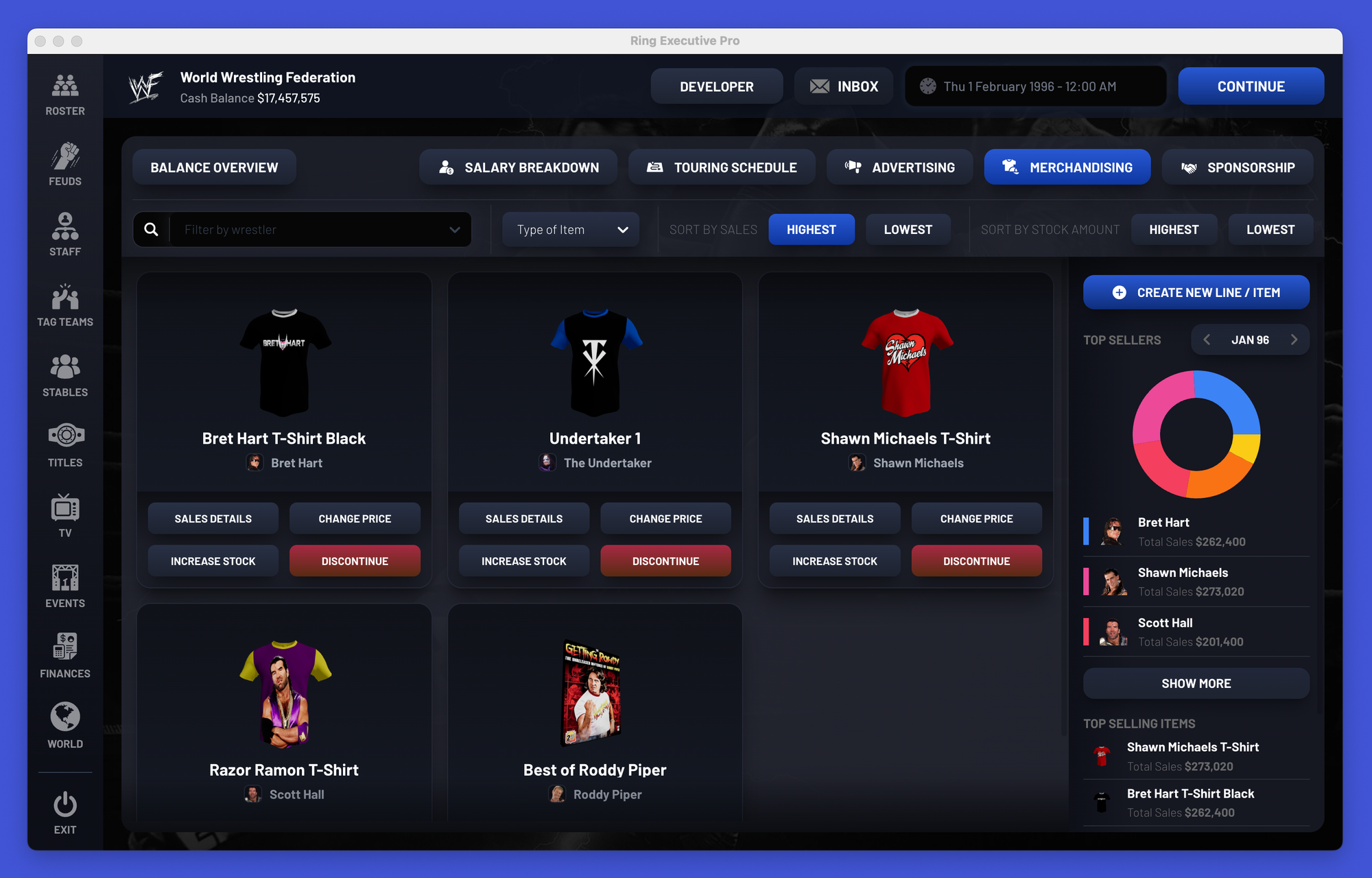
This screen allows you to create actual merchandise for your wrestlers and make decisions on how much stock to purchase.
For the former, you can actually design each piece of merchandise (t-shirt, dvd, foam hand or baseball cap) in a 3D designer which allows you to set colors for individual parts of the item, add text and image layers and so on.
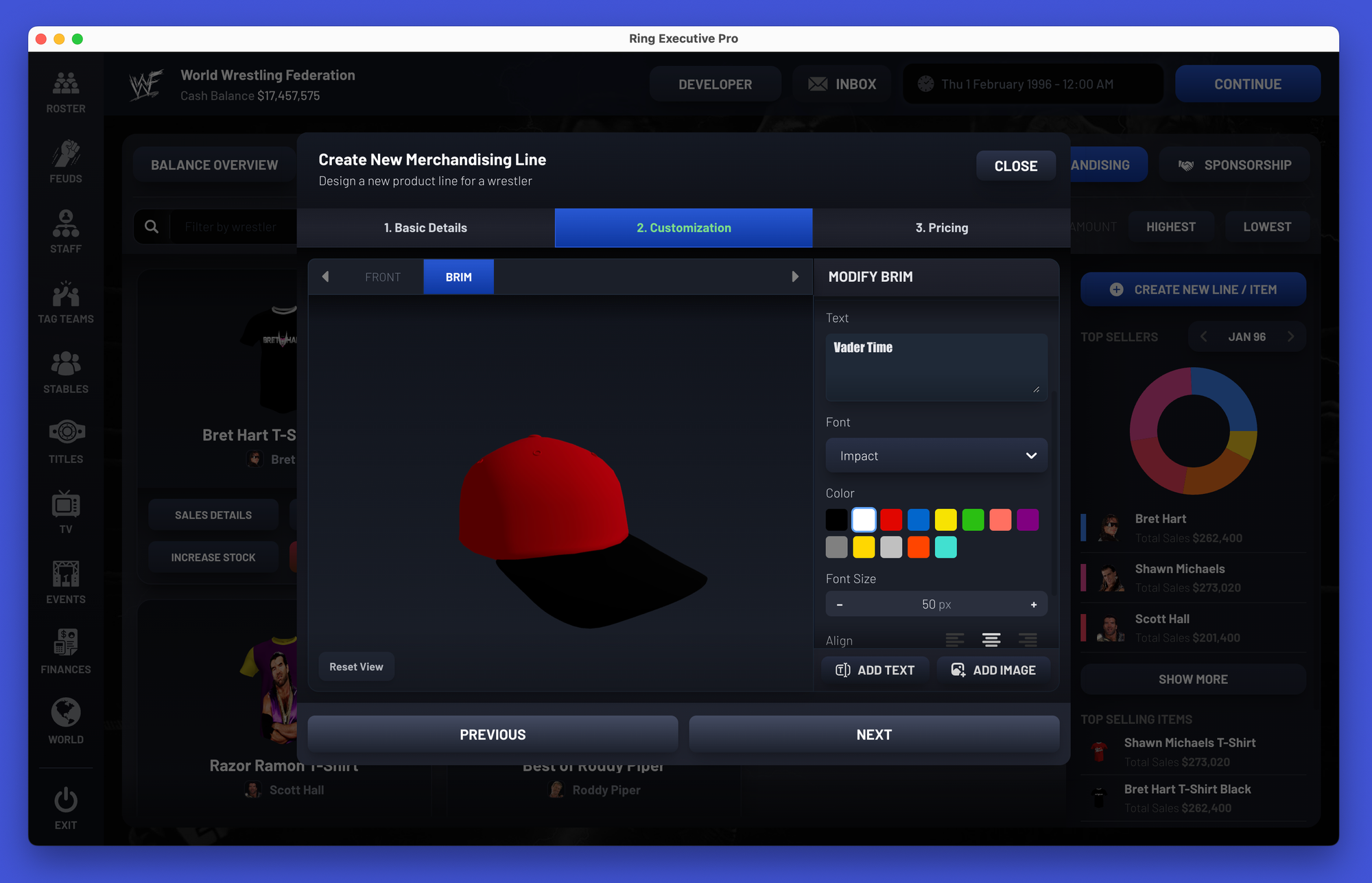
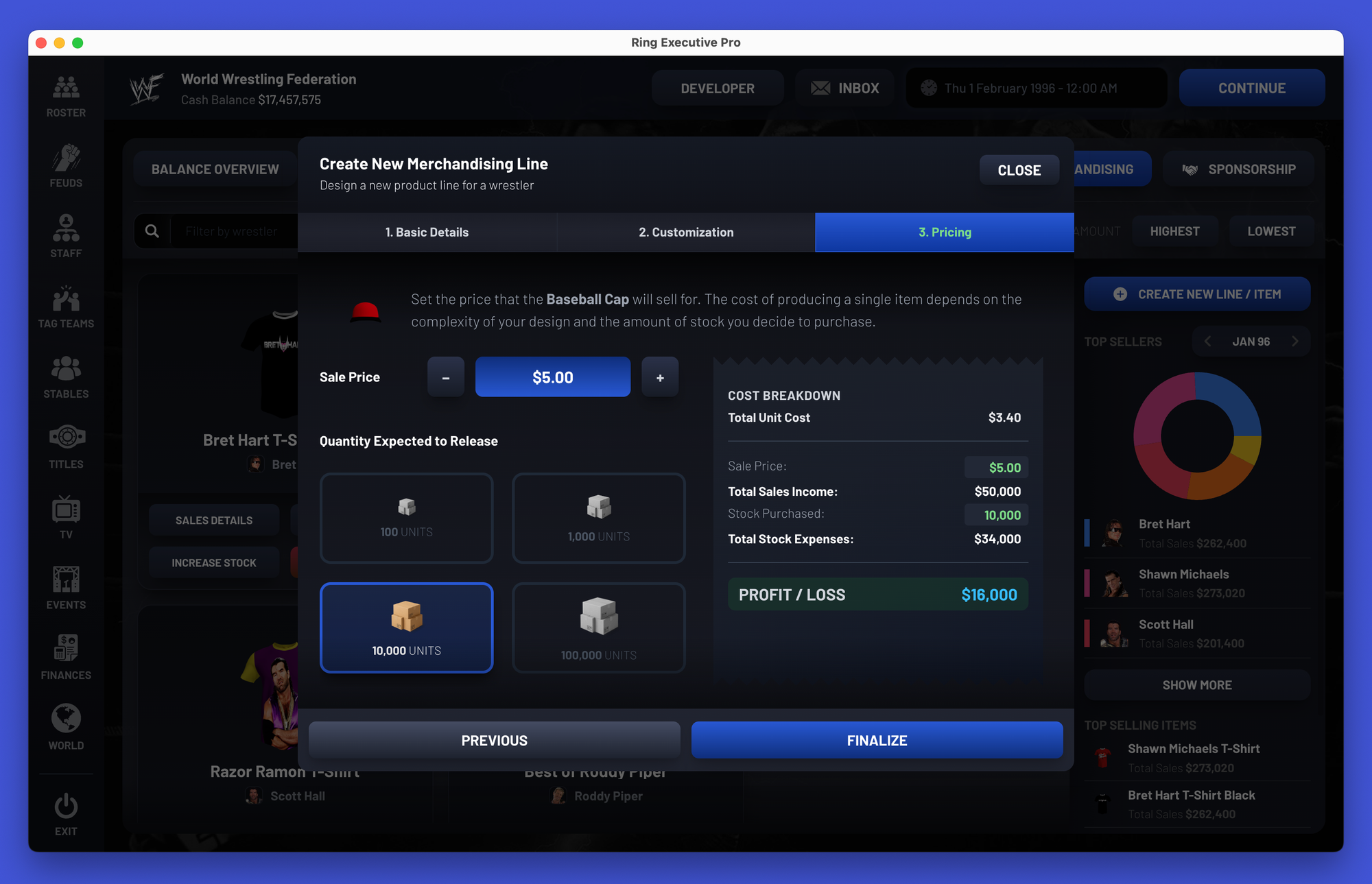
Once you create the item, just like in games like Pizza Tycoon, the game will run an algo on the final product and determine a quality rating (which is kept hidden but you can get a good idea of what it is based on sales of the item).
Once the product has been created (the final step is to set a sale price), you have to choose how much stock to purchase before the product line becomes active.
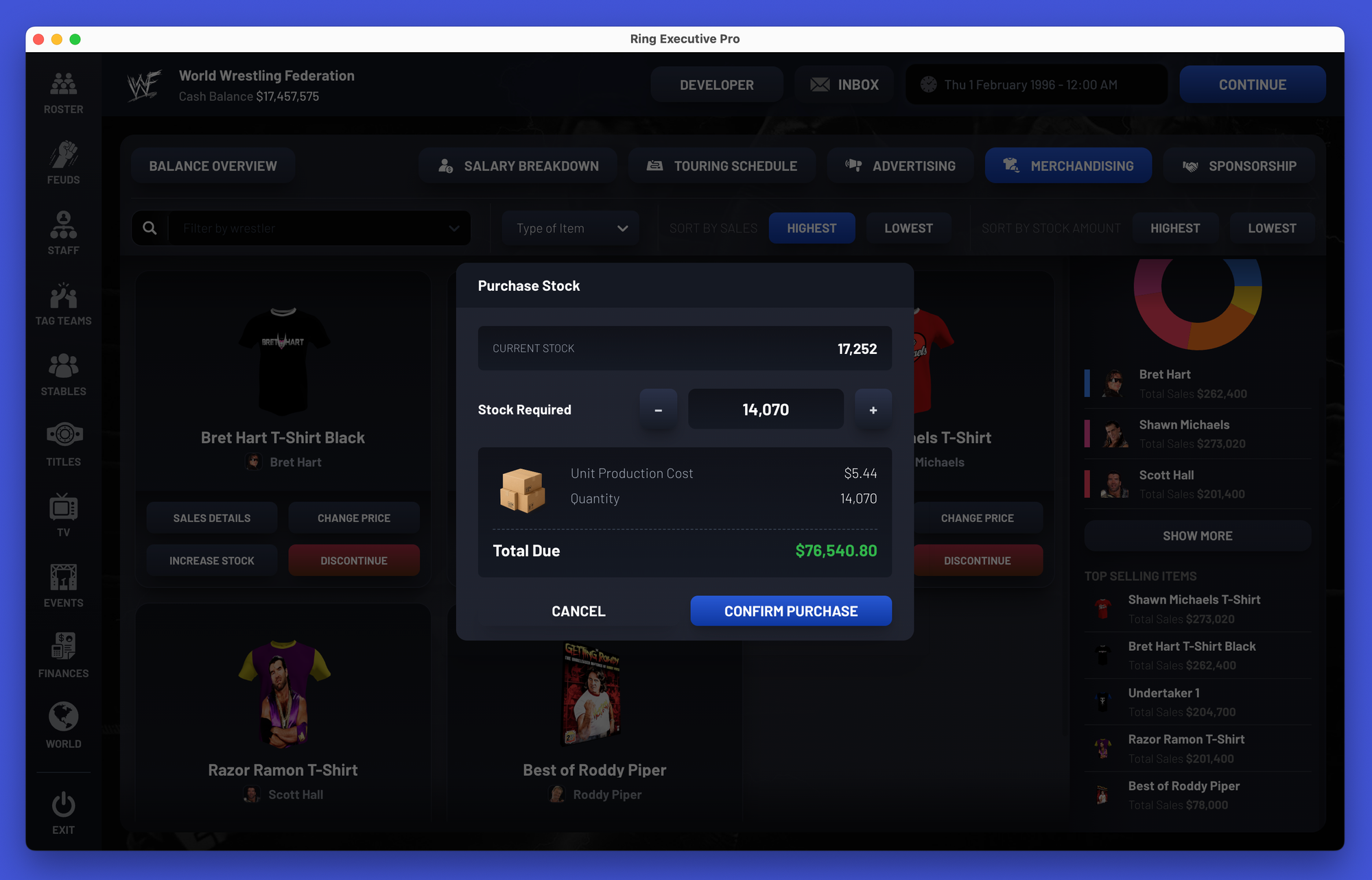
When purchasing stock, the economies of scale kicks in. The more stock you purchase, the cheaper the unit cost of each item and therefore higher profit for you. But the risk is you end up tying up capital in that stock and you're only one injury or cool off away from being stuck with a load of unwanted merchandise.
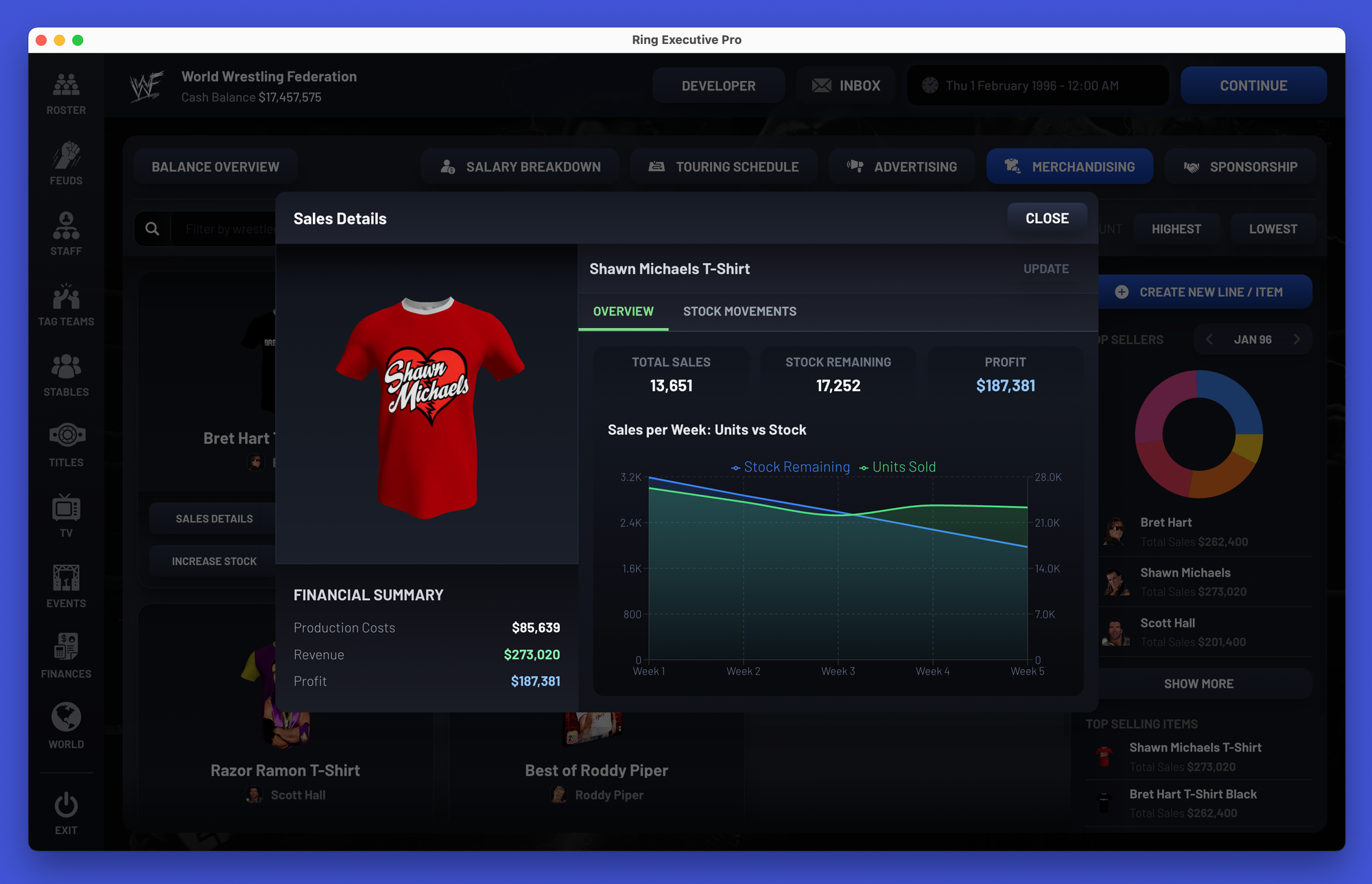
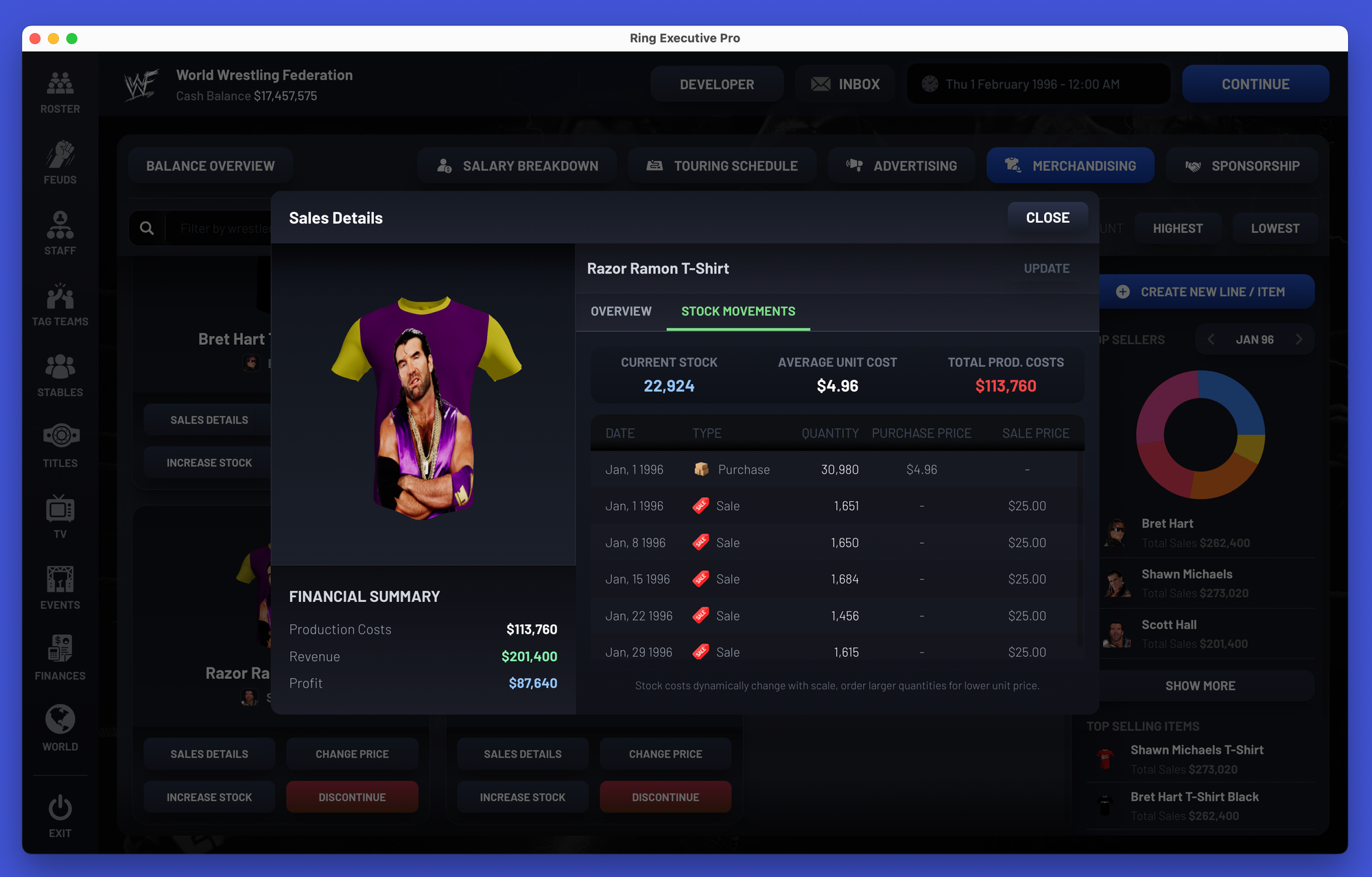
The sales sidebar and merchandise item drill down screens allow you can keep track of sales, stock movement and see how profitable a line is.
A top tier wrestler like Stone Cold or Hulk Hogan might have a theoretical cap of $3m/year in merchandise sales. If you're able to capitalize on them properly by releasing fresh lines and replenishing stock when it runs out - the idea is that through merchandise sales alone, you can offset some or even all of the costs of signing such a wrestler!
Finally, the Sponsorship Screen
You might have already seen in the booking screenshots that I released earlier this year, that when you book TV shows, there's a side track on the show booking timeline where you can drop "Sponsor" segments.
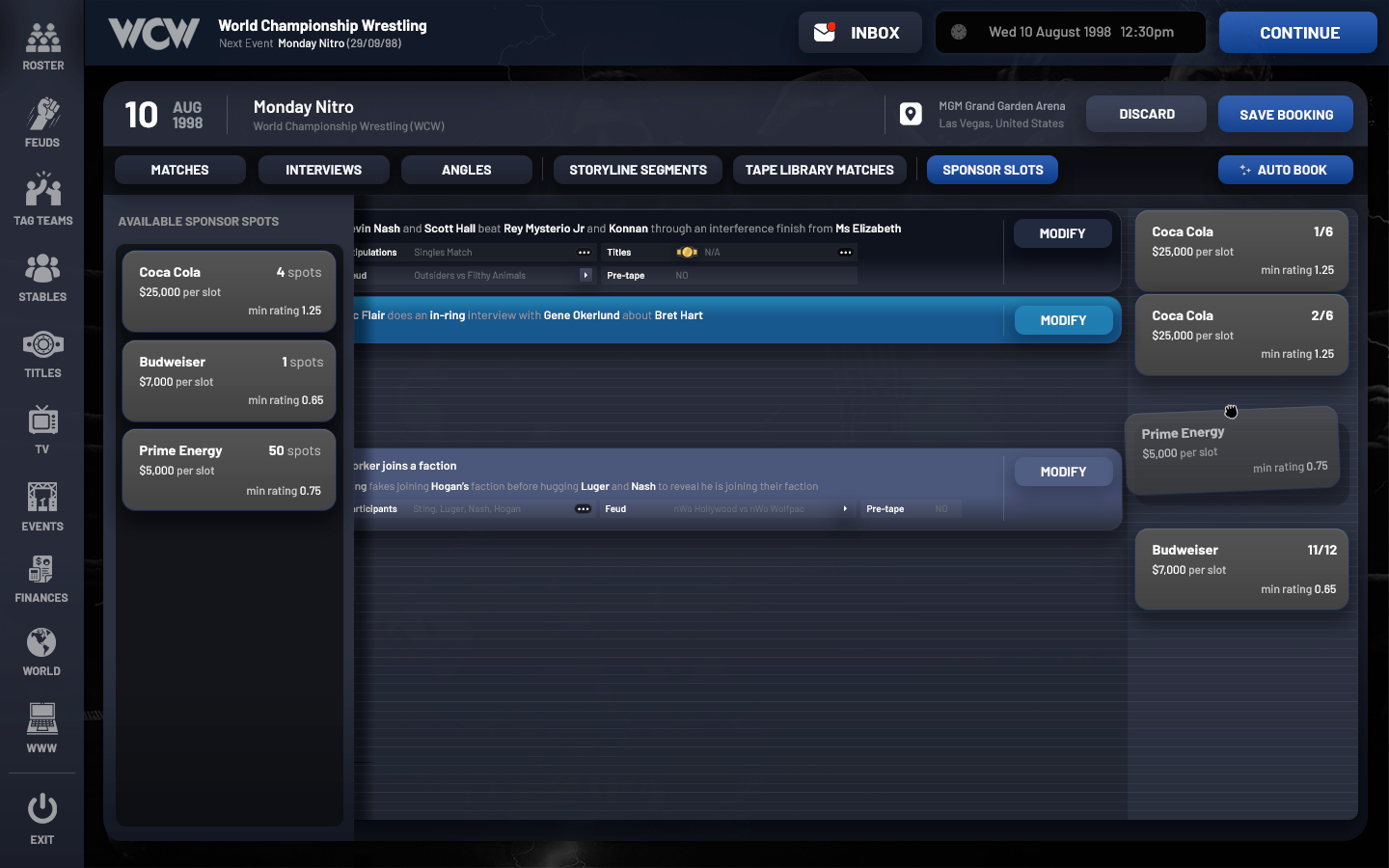
You get those "opportunities" from the Sponsorship screen which shows you a list of available opportunities. These are replenished every month.
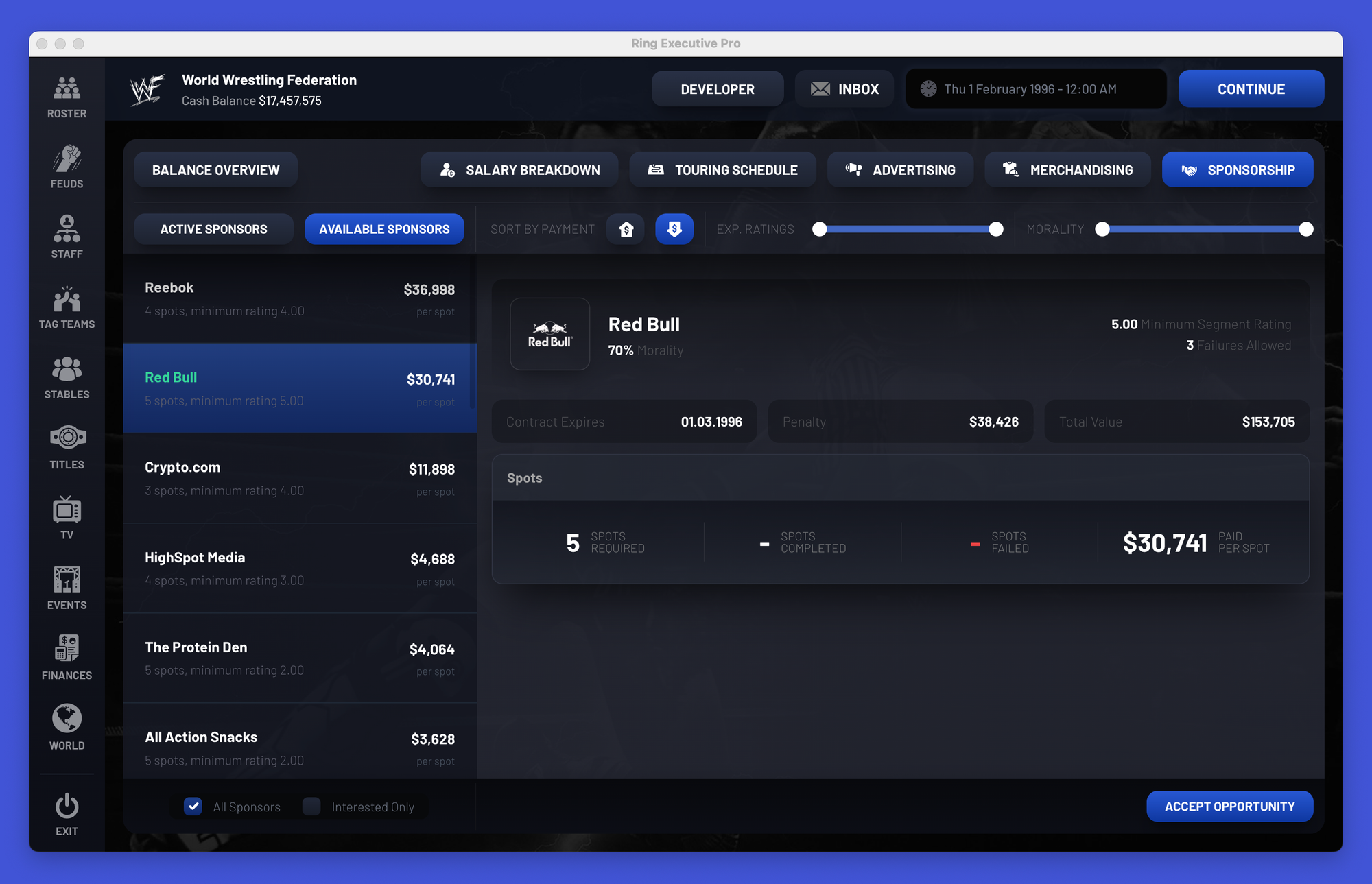
I've created a diverse set of brands - from well established brands like HBO, Nike and Microsoft down to local entities like gyms, energy drinks, podcasts and so on. The high value brands just like in real life aren't very enthusiastic about being associated with wrestling so you will only see them pop up if you are a big global promotion.
The idea with sponsorships was to give you a way to earn extra income on top of your TV deal - you drag over these segments and as long as you fulfill the criteria of the brand (e.g. minimum ratings), you will get paid for the spot.
However, accepting an opportunity handicaps you. It means you must adhere to the values of the brand - so for example toning down your content if you're sponsored by Coca Cola. They might also make certain requests (feature Wrestler X during our segments).
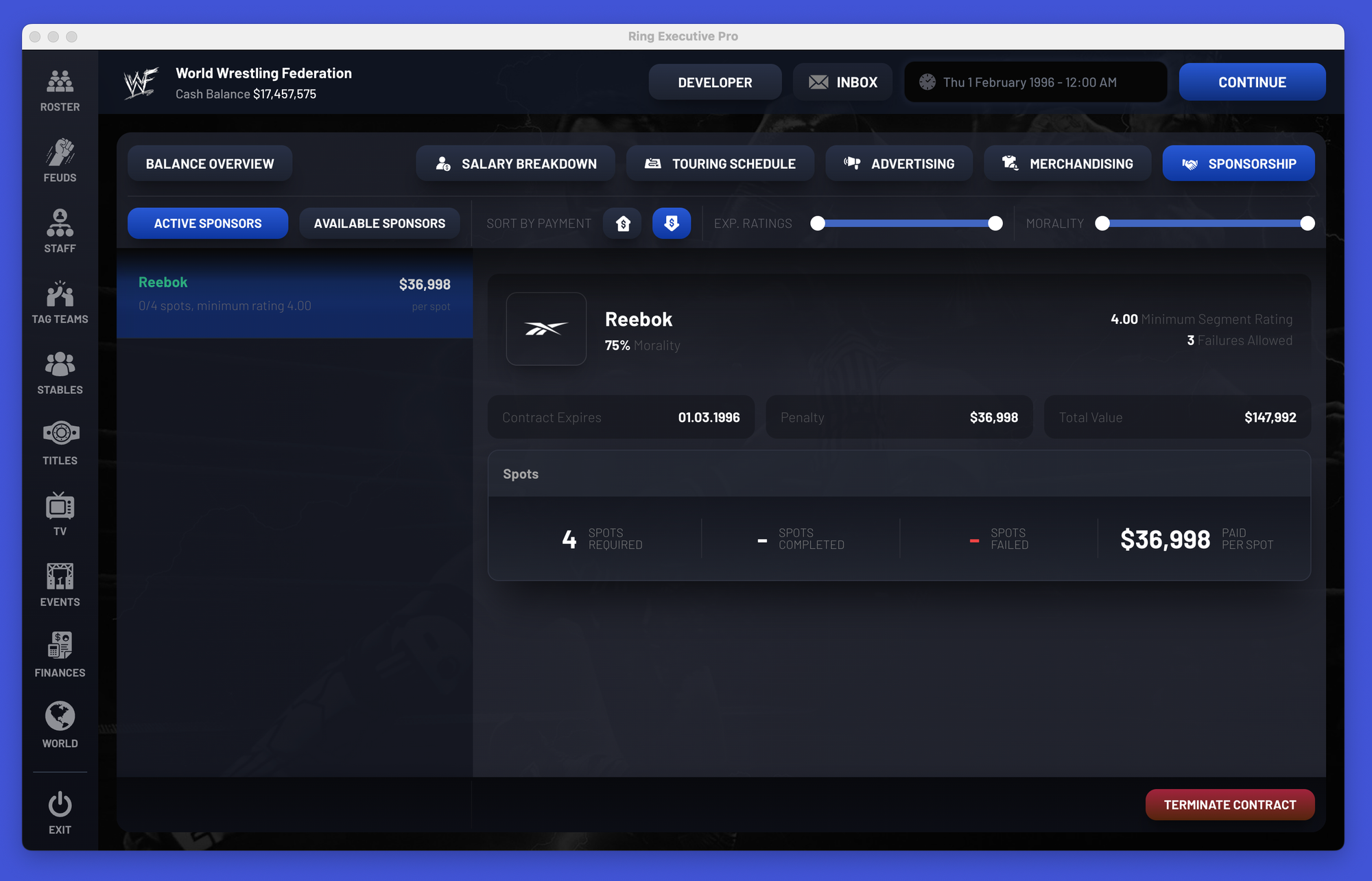
As well as tying your hands up with their demands, sponsors will also charge you a penalty fee if you can't complete all the spots the contract requires. So it means you have to be careful about what opportunities and how many you accept.
Like the advertising agencies, brands remember previous interactions - failing to fulfill a contract or terminating one early will mean they'll either be reluctant or not willing to offer you any further opportunities.
So as you can see there's a lot of that went into the game since my last update.
Since there was a near two month gap between writing a lot of this code, I'm afraid that this release might have a few bugs in it.
My goal was to try and wrap up the game so it's playable so I wasn't focused as much on getting every feature polished - it's far more important that you guys can see the vision and give me useful feedback and the basics of the game-play is in place because I can always come back and polish things off later.
What's next?
The contract system is the next big feature I want to finish off. After that, it will be a case of nailing various game progression issues (e.g. workers aging, contracts expiring etc) before I move onto finishing the remaining booking/story-line screens.
That will leave the match engine as the final component of the game before I can consider the game playable.
I'm desperately hoping that I don't suffer any further complications in my personal life so we can keep things on track - let's hope my next update won't take such a long time. If you have any feedback, please comment on this post, join the Discord or send me an email.

Member discussion: